Phase Two

The
Blueprint

You've seen where you are. Now you decide who you're becoming, and build the first structure to get there.

The Honest Audit was about looking clearly at the present. The Blueprint is about naming the future precisely enough to build toward it, and pre-deciding what you'll do when you slip.

It has four parts: the Objective (what you actually want), the Declaration (it, written as already true), who you have to become (the identity the goal requires), and your if/then plans (decided now, while you're calm, for the depleted version of you who'll need them later).

Have your Honest Audit nearby. This phase builds directly on it. Your answers save on this device as you go, and your finished Blueprint is sent to me as well, so it's backed up and I can read it if you'd like.

4 parts Saves as you go

Rather do this with me live? Book a session.

Before we start
First, who's building this?
So your finished Blueprint reaches me too, in case you ever want me to read it or you lose your copy.
Your name
Your email
Saved
Part 01 / 04 — The Objective
What do you actually want? Name it as a concrete objective.
Not a feeling, a target. Specific enough that you'd know if you hit it.
How to do this well

Look back at your audit, especially the gap between who you said you'd be and who you became. The objective usually lives in that gap.

Include the constraint that matters. An example from a first participant: "I build income that reliably produces $400k a year to sustain my life and my family, without the stress that defined the last one." The "without the stress" part is doing real work, it names what you're not willing to repeat.

One caution: if you're carrying a one-time recovery number (debt, a loss) and an ongoing sustaining number, keep them separate. The recovery number often can't be planned until the next thing is defined, so forcing it here only manufactures the pressure you're trying to leave behind.

Saved
Part 02 / 04 — The Declaration
Now write it as if it's already true. Present tense.
The same objective, but stated as a present reality, including the part about enjoying it.
How to do this well

Present tense is the point. Not "I will," but "I am." Example: "I'm making over $400k income per year, from a business, and I have time to spend with my family and friends, and I really enjoy doing it."

Notice the last clause. The enjoyment, the thing the structure has to actively protect, because it's usually the first thing to disappear. Write yours to include how it feels, not just what it produces.

If there's a real fork in it (mine or someone else's, this path or that one), leave it in rather than resolving it now. Naming the fork honestly is better than forcing a false certainty.

Saved
Part 03 / 04 — Who you have to become
Write three identity statements. Each one an answer to a pattern from your audit.
Present tense, and each one should correct something specific you saw in the Honest Audit.
How to do this well

These aren't aspirations pulled from a menu. Each should be the direct answer to a real pattern you named. Three corrections to actual patterns beat five confident buzzwords.

The method: take a drain, a thing you tolerated, or a way you kept getting stuck, and write the version of you that doesn't do that anymore. Examples from a first participant:

"I build with people I trust, and I let them carry what's theirs." (The answer to carrying it all alone.)
"I see people and numbers as they are, not as I need them to be, and I act early." (The answer to hoping instead of seeing.)
"I follow through on the structure even when the excitement is gone." (The answer to starting systems and dropping them.)

If one of your three feels vague, cut it. Two true ones beat three where one is filler.

Identity statement 1
Identity statement 2
Identity statement 3 (optional if the first two are strong)
Saved
Part 04 / 04 — Your if/then plans
Pre-decide what you'll do when you slip. Write two or three.
Decided now, while you're calm, for the depleted version of you who will need them later.
How to do this well

Each one names a specific warning sign and the exact action you'll take, decided in advance so you don't have to decide it while depleted. The structure is: "If I notice [specific sign], then I [specific action]."

Draw the "if" from your own failure patterns in the audit. The best ones tend to circle the same core correction. An example: "If I notice I've started tracking the finances myself every day again, then I call a full pause, not a tweak, until we've found the root and resolved who takes the reins."

Make the action concrete and time-bound where it helps. "I have the honest conversation and put a written plan in place with a horizon of no more than one month" is usable. "I'll try to do better" is not.

If / then 1
If / then 2
If / then 3 (optional)
Saved
Your Blueprint

This is what you'll return to every week.

Everything you just wrote, in one place. This is the document the rest of the program builds on. Save it, print it, keep it where you'll see it.

The Objective

The Declaration

Who I'm becoming

    My if/then plans

    Your progress
    2 of 7 complete
    The full arc
    Done
    1. The Honest Audit — See clearly where you are.
    Done
    2. The Blueprint — Decide what you're building and who you're becoming.
     
    3. The Clearing — Remove what stands in the way.
     
    4. The Dashboard & Weekly Reset — Build the structure that moves your goal, and run it.
     
    5. Energy — Protect the capacity it all runs on.
     
    6. Becoming Compatible — Close the gap between where you are and what the goal requires.
     
    7. Integration — Make it permanent, so it runs without force.

    Phases three onward are where we work together.
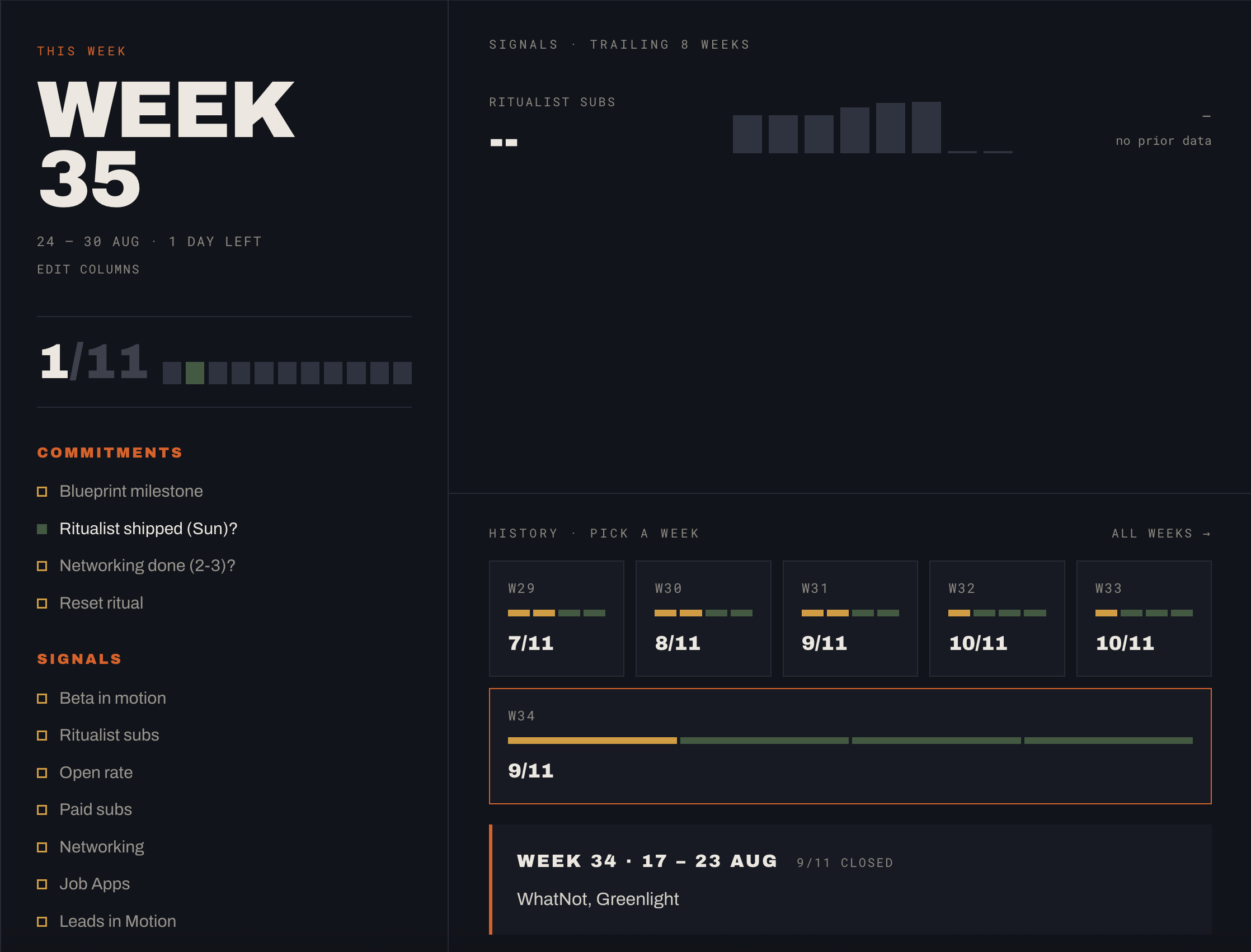
    A preview of your weekly dashboard
    Weekly dashboard preview showing commitments, signals, and condition checks

    Your one page for the week: the few commitments that matter, the signals you track, and the conditions to watch.

    You've done the two phases that matter most — the ones you do on your own. The looking back, and the deciding. Most people never do them.

    The rest — building your weekly reset and having someone hold you to it until the rhythm is yours — you do with me. If you want to keep going, book a time and I'll read your Blueprint before we talk.

    Book a session →